Sunday, October 20, 2019

It all Ends

Image result for deathly hallows harry potter advertisement
Warner Bros.          Released: June 14, 2011


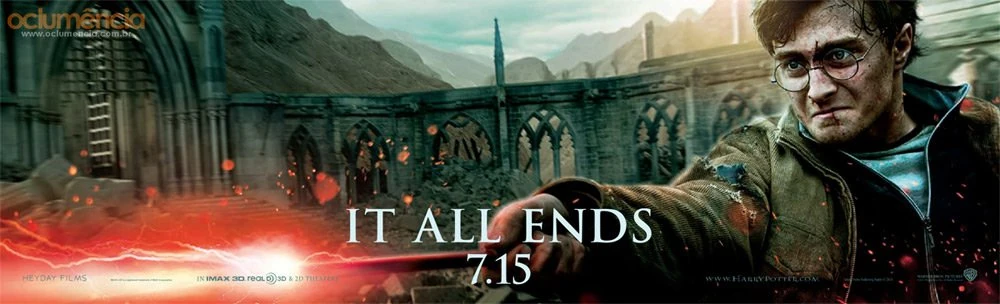
I can remember waiting for Harry Potter and the Deathly Hallows Prt. 2 to be released anxiously, counting down each day till 7/15 rolled around. Leading up 30 days before the film's release, a series of advertisement banners were published by Warner Bros (presenting Heyday Films, the creator of the Harry Potter films). They were published on billboards, media, and on the official Harry Potter website. Each banner, like the one above, featured a key character from the movies and the phrase "it all ends" with the films release date stamped on it. On many of these banner, the actual title of the film was not even listed. 

Those of us who have been longtime fans of the books and films obviously knew the movie without question. If you were to look at the poster and not know the film title, it would be almost defeating. This introduces the sin these banners tackle: envy. The popularity of these movies was so insane that the producers of the ad left the title of the movie off the posters. So that when someone who didn't recognize the film looked at the ad it would be upsetting not to know. The lack of the title meant that most people knew what the film was. The phrase on the banner signifies the admiration fans must have for the plot. Envy comes in play here for those who did not know. With the lack of a title, they find themselves wanting to know and wanting to become apart of the majority. The intense scene painted on each banner drew in this audience. They began to want to know the story and wanted to know primarily what was ending and what they were missing out on. 

Another way to view this ad is within the sin of lgreed. In some way, the desire fans had for the next movie and a conclusion can show greed because they wanted the possession of this thing. At the point these ads were released, the sneak peak of the scene on each captivated those with what they were craving. This ad preys off the greed and desire of its viewers. 

Lastly, within the actual scene depicted on the banners themselves, one may note the sin of wrath. This sin is established through the banner above as well as this one. In both, two opposing enemies are shown. Both of these people are using extreme force to "end" something. The emotion in their faces combined with the phrase establish that only one of them will come out alive within their battle. Wrath here is the hate they may have for each other as enemies and their use of force to end the fight. 

These posters were intended for audience of established fans invested in the franchise as well as those who had never heard of the films. The age range of fans for Harry Potter is so vast that one cannot but a boundary on it. The ads would draw this audience into a movie theater. This would mean they were probably catering them to the middle class due to how upper class may not join in on that form of entertainment and lower class may not be able to afford it. However, I would say that movies are generally targeted at anyone who wants to attend. Culturally, they are vastly popular and cater to a large variety of people without requiring much beforehand knowledge. 

Through a wide lens, this type of advertising can be seen throughout modern years. Many companies, such as Netflix, have become competitors to theaters and cable through their services. Netflix and other companies also now do advertising featuring notable characters without labeling their names or shows. This idea of suspense creates excitement in those who are knowledgeable and longing in those who aren't-- either way, drawing in many viewers. This banner may have just been the start to a whole new genre of advertising that we now view as common rather than as radical as it was in its time. 

Sunday, October 6, 2019

I am Abby

Image result for abby meaning
Abby: A meaning and origin 

If you ask me about my first name ever, you will soon come to find my disliking for it. My name is just a name. It is a construct of letters attempting to give me some type of identity. Because I am tragically named Abigail, I am just one of the thousands of girls stuck with this label. According to SSA data, in my birth year of 2002 alone, "Abigail" was among the top five most popular girl names in over eighteen states. Just imagine how original I felt in a classroom with six other "Abbys" and at least two "Abigails." But, if you were to ask my parents why they picked it-- my unoriginal, boring, horrible name-- their answer is simply, "because it sounds pretty." However, in a world where who you are is everything and finding your identity helps define your purpose, "it sounds pretty" isn't good enough-- or, at least, it never has been good enough for me.

I live my life trying to be the opposite of an Abby. To me: an Abby blends in, an Abby doesn't stand up for what they believe in, and an Abby doesn't make a difference. When you are given one of the most common American names, it is hard to ever imagine being an individual. Let alone an outstanding individual on a mission to change the world for the better. So, why not change my name you wonder? Well, changing my name just changes my label. For me at least, my label has never been who I am. Who I am is not a "father's joy" as the Hebrew meaning of my name would lead on. Who I am isn't even my last name of "Regan" that connects to my deep family ties and bond. And of course, who I am is not a basic girl with a basic name.

Despite this, it hasn't always been so simple to break free of my labels. Besides my name, I label myself and my feelings all the time. Presenting the battle of duality I face-- my labels vs. the real truth among them. It is easy to call yourself stupid. It is easy to brand yourself with expectations that you try hopelessly to fulfill. The human language has given us the means to literally express our thoughts. What language fails to do, however, is give justice to the truth. Just as my name doesn't define who I am, neither do the labels I call myself. I have learned that one must look past the "what" and develop the "how," the "why," and the "so what" to truly begin to grasp the truth. Words are just labels. They are the exterior walls that can block away all that lay inside.

So, maybe instead of just,"I am Abby," we should try something like...


I am courageous because I push myself beyond my anxieties.

I am kind because I know how hard life can be and how much a kind soul can help.

I am curious because the world is so wide that I can't help but dive in and ask questions. 

I am open-minded because it opens new doors to growth and love. 

I am unique because I project my off-brand weirdness to the world everyday.


But most importantly...

I am Abby because I am all of these and more. So yeah, I am Abby, and I guess I am proud of that. 

Sunday, September 22, 2019

Deception in Perception

Wing Young Huie captures just a moment in time. He gets to choose the setting, the angles, the lighting, and even the subjects-- but not how they are perceived. As a photographer, all one can do is influence that perception but never make it for the audience itself. The same goes for an author. Margaret Atwood's techniques lie in narration, language, setting, and devices. Just like Huie, she can shape the readers perspective but can never force it upon the reader. Thus, both creators explore the use of creative license and interpretation within their fields with various techniques-- ultimately, promoting their own way to express "otherlings." 

This photograph was taken as a part in Huie's collection Lake Street USA (1997-2000). It was titled "Big Geno and Little Geno" and was taken in Minneapolis, Minnesota. The lens depicts a man holding up a small puppy on a thick, chunky metal chain. The name of the man photographed is Geno and the name of the puppy was Little Geno. 

Upon first glance, one may judge the picture out of context. Geno has a rough, tight grip on the puppy and the dog seems to look sad almost. The coloring within the photograph takes life away and highlights the negative aspects within the photograph. Specifically, it makes the chain stand out more. The bulky chain seems to weigh down the puppy's neck. The man's expression could be interpreted as pleasant and proud of showing his dog on the chain. Many viewers of this photograph may see this piece as a commentary on dog fighting or animal abuse. But, when looking closer, the key to this photograph is understanding the man behind the lens. 

Huie states, "When photographing I try to present people as they present themselves and let viewers form their own narratives. A photograph, however, is just a snippet of that person. If you took a thousand photographs of someone, which photograph would be truest? And who decides the truth about any photograph—the person in it, the person who took it, or the person looking at it?"
Now, applying this concept to the picture, a new perspective can be explored. The viewer only has so much detail on the man and his life. By the looks of the setting, his neighborhood is a bit run down. He wears a "wife beater" tank top and sweats. His skin is black. All of these points are aspects Huie is choosing to showcase. The colors of each draw to that significant through black and white. The focus while on the man's expression, is taken away by the viewer being drawn to the puppy in the photo. Because, in the photograph, it is the reflection of innocence. This is where Huie is making his commentary. 

Huie is pointing out things that can be stereotyped easily in society. He is drawing attention to the race of the man. Not in the sense to point blame or paint that race in a negative light, but to instead show how little viewers know. Huie has constructed a photograph in which a viewer pretty much immediately receives as wrong and almost disturbing. He wants the audience, on a larger scale, to see what is beyond his lens and how easy it is to manipulate perspective. By a few technical choices, Huie can change the interpretation of its viewer.

In a way, through the words he writes underneath, he is challenging the viewer to be better. He describes the real story behind the photograph and the true intentions of the man. Instead of a story of abuse, he describes a man who loves his dog and is choosing to train it with a chain to make it stronger. Showing that, what you see and what you read, is not always what is there. 

Atwood constantly makes the same point throughout her novel, The Handmaid's Tale. By telling the story completely in Offred's narrative, the audience is only given a biased viewpoint of all the events at hand. We see each event as a fragment of her subconscious watching through her eyes and emotions. Beyond that even, every choice within the book is purposefully made by Atwood to influence her audience. Thus, she can manipulate the audience to view anyone as "othering" through her choices of techniques just like Huie did. Huie made the man seem "othering" through how he seemed to be okay with this animal abuse, even if that wasn't the case or the truth in the story. So, Atwood is able to do the same thing as an author. 

For instance, Atwood describes Serena Joy in the book as supportive of the Gilead society. By flipping between past and present in the factored text, the reader only gets to hear certain stories about Serena Joy-- most of which negative in nature. The audience most likely will develop an opinion on her that aligns with Offred's own opinion. But, if the reader is able to recognize that bias and manipulation in the text, they begin to develop a new opinion of Serena Joy. They watch her struggle as she too is unhappy and oppressed in the society she helped create. They also watch her get cheated on again. They begin to see her as her own individual and just another person oppressed in Gilead. Instead of this odd creature, she becomes human to the audience. 

The point being, both the photographer, Huie, and the author, Atwood, strive to make the use of bias and creative manipulation clear within their works. Both actively take advantage of techniques to influence the audience to hit on surface level themes and interpretations, especially when it comes to their presentation of "otherings". However, the key here is recognizing this and how they use it to help promote the deeper themes within their pieces. Through that outlook, the audience is able to gain a wider perspective that is more informed and more truthful.