Sunday, March 8, 2020

Lady Macbeth IOC Practice

IOC Recording


Prep Documents


Criteria: 
A: I felt like I had a good overall knowledge and understanding but I was so nervous that it did not come through. I would give myself a 4-5 on this. It was superficial in the sense I made claims but barely backed them up with examples. It verged on adequate because some of these were backed up and supported the context. 
B: I would give myself a 3-4 because I mentioned literary features but did not go into much dept and struggled with referencing examples. This was really hard for me to figure out because my organization fluctuated within the IOC pratice. 
C: Organization was like a 2-- because of this, the rest of my IOC practice struggled. I found myself forgetting to mention Shakespeares name and connecting to my claim. I also found myself jumping around from point to point. 
D: My language was a 2 because it was occasionally clear but I used terms such as "like" and "sneaky" because of my nerves. I needed to be more professional and flow each section and point together more. 

Sunday, February 23, 2020

A Nation of Translations

Metamorphosis by Franz Kafka 
The novel, Metamorphosis by Franz Kafka, was published originally in 1915. The plot of this novel is about Gregor Samsa, the main character, transforming into an insect and his struggle with this identity. He is author who has highlighted the genre of absurdity through the reaction of the public after World War I. However, Camus argues that Kafka rather failed at this genre because his works establish hope. 

This blog post will compare the aspects of diction, syntax, imagery, structure, etc through four different translations to establish the importance and affect of each. 

Original: Als Gregor Samsa eines Morgens aus unruhigen Träumen erwachte, fand er sich in seinem Bett zu einem ungeheuren Ungeziefer verwandelt.

#1: Gregory Samsa woke from uneasy dreams one morning to find himself changed into a giant bug.
  • diction (connotation/denotation): 
    • Uneasy: negative connotation due it being uncomfortable for one to feel "unsure" and not good. The word implies something about the dreams were disturbing in nature and not typical. 
    • Giant: The word means he was huge which could translate to the struggle as well being giant. It is of medium of intensity in scale descriptors. 
    • Changed: That something had to have caused the change and it was just a difference in appearance. 
    • Bug: It has a slight negative connotation becomes it begins to border on the pest side rather than the proper terminology side. It also is how like a kid or someone talking quickly would probably describe the insect-- especially someone with little knowledge of the bug. 
  • syntax: 
    • Woke vs. Awoke 
    • The sentence is direct in nature by giving out a lot of facts in a medium-short sentence.
    • The process of the sentence follows the process Samsa would have gone through to find out he was a bug: woken up, noted the dreams, discovered the new truth. 
  • imagery/details:
    • Giant: The bug he has turned into is not just a tiny insect, but one of a large quality. This could either mean as far as insect measurements go, he is giant or that he is a man-sized insect. 
    • Set the setting: his bedroom and the time: One morning
    • Keeps it elusive enough that time is listed by not necessarily specified in memory-- it was just "one morning." 
  • structure: 
    • The sentence length is medium to short and it is concise.
    • There is not much imagery or narrative just basics. 
    • This overall summarizes the events which almost minimizes them and makes them seem natural. 
    • No punctuation pauses


#2: When Gregor Samsa awoke from troubled dreams one morning he found he had been transformed in his bed into an enormous bug.

  • diction (connotation/denotation): 
    • Troubled: This word has a very negative connotation because it implies that they presented an issue to Samsa and caused a true disturbance. 
    • The addition of "in his bed" concludes that he realized quickly as well as in a place of comfort. 
    • Transformed: The word implies a dramatic change and one that could alter more than just appearance. 
    • Enormous: This word would be bigger than "giant" and is more expressive in nature. 
    • Bug: Same observations as translation one. 
  • syntax:
    • Woke vs. Awoke
    • When being first in the sentence gives the sentence a sense of time and order.
    • The most important details start and conclude the sentence. 
  • imagery/details:
    • Sets the scene: setting of his bed and time: one morning 
    • Present sense of time flow
    • Enormous: Makes him as a bug seem larger than life and a normal sized insect.
    • Note the lack of specificity when it comes to bug type and general lack of extreme detail. 
  • structure:
    • Again, the sentence length is shorter and to the point. This sentence stretches on the longer side because it mentions the bed in it. 
    • Not any punctuation pauses 

#3: As Gregor Samsa awoke one morning from uneasy dreams he found himself transformed in his bed into a gigantic insect.

  • diction (connotation/denotation) 
    • Uneasy: Same as translation one.
    • Dreams: This word usually has a positive connotation and one would typically use the word "nightmare" if wanting completely negative. This could imply some hope in the sentence and overall story. 
    • Transformed: Same as translation two. 
    • Gigantic: This term would be between giant and enormous on a scale. It provides a medium ground between the two. 
    • As: Immediately upon waking up is when this occurred-- gives a "live action" play-by-play of the event almost. 
    • Insect: It is a more accurate terminology of the bug which presents that there could be more knowledge on it but also creates distance. 
  • syntax:
    • Woke vs. awoke
    • Setting of time is presented first
    • Sentence ends with the mention of the insect and begins with his name: contrast?
  • imagery/details
    • Setting: in bed, time: "as" and one morning 
    • Gives an idea to the size of bug he has changed into 
    • Little imagery 
  • structure:
    • A longer sentence about the same length as translation 2 
    • No punctuation or pauses 
    • Summation of events: direct, factual, etc  

#4: One morning, upon awakening from agitated dreams, Gregor Samsa found himself, in his bed, transformed into a monstrous vermin.

  • diction (connotation/denotation:
    • Agitated: It introduces how Samsa felt about the dreams and how they were negative because they annoyed/bothered him greatly.
    • Transformed: Same as above translations.
    • Monstrous: Instead of a size, this description shows how Samsa and the author felt about his transformation. They both see it as negative and there is a sense of "ugly" or evil with that term.
    • Vermin: This term is extremely negative and could be applied to more than just bugs. It shows their feelings again and shows that they are disgusted by it. It also shows ignorance almost from lack of understanding, knowledge, or appreciation. 
  • syntax:
    • Begins the sentence with introducing the time and event that awoke him, then introduces who he is, where he is, and the conflict. 
    • Awakening vs. woke/awoke
    • Puts him closer together with the direct conflict 
  • imagery/details:
    • The use of monstrous and vermin introduces the thought that he is ugly and may be deformed. While it gives detail on those ends, it lacks specificity when it comes to the vermin type, size, etc. 
  • structure:
    • Continuous use of commas and punctuation 
    • Pauses created by those 
    • Chucks up the setting vs. the more important details/narrative
Concluding Questions: How does the word choice, syntax, punctuation, and imagery shift in each affect meaning? Is one more effective than another? Why? What does this exercise bring up about the difficulty of reading translated texts? How do different translations effect the tone of the sentence?

All four of those-- word choice, syntax, punctuation, and imagery-- are key concepts manipulated by the author to convey their message/their purpose. When looking at word choice, the word changes the way the readers feel about what they are reading through varying tones, moods, and meaning. The author uses different words and uses their connotations and denotations to implicate how the characters feel and reflect that to readers. In turn, word choice will also vary all of the other elements of text and can easily change the meaning of just one sentence-- as seen above. Which is why, as a result, translation accuracy and the bias of the translator must be kept in mind by any critical readers. Syntax utilizes the words chosen to create a "image" with the way they are presented in the sentence sequence. This small detail in itself can help compare/contrast ideas and emphasize points the author wants to make. Punctuation aligns with syntax to create the structure of a sentence. It affects length and pacing which can alter the tone and mood of the text. Also, the use of commas and pauses can highlight key events or break up the sentence. Imagery, lastly, gives the audience the majority of the information about the text. This can include setting, time, feelings, descriptions, thoughts, etc. Imagery helps the audience visualize the characters and scenes more effectively which in turn can help the texts' messages be greater understood. On the other hand, the lack of imagery is also a style used by some authors to present a whole knew message or comment. Personally, to me, all four elements rely on each other and change when they change individually. If one had to be chosen as the most effective, I would pinpoint it to be the diction or word choice of the piece. It seems any true author knows the importance how the words they chose to convey their messages and how each word can pack a powerful punch. Word choice is what most directly can alter meaning, audience reception, message, and all three other elements the most effectively. 

Through the exercise, it is apparent that all elements such as the four listed are incredibly important to take into account by readers. The translation of a piece of literature can unintentionally alter any element and therefore change the original intention of the novel. It shows why context and background knowledge about the novel/author as well as the translations are key to know as a critical reader. If those are noted and researched properly, the reader will likely be able to understand the text as closely to the original intention of the author as possible. While in these four sentences, the main ideas are still present, the tone shifts from each. This shift in tone shows the affect of these elements and how as a reader, we might evaluate them differently because of it. 

Sunday, January 26, 2020

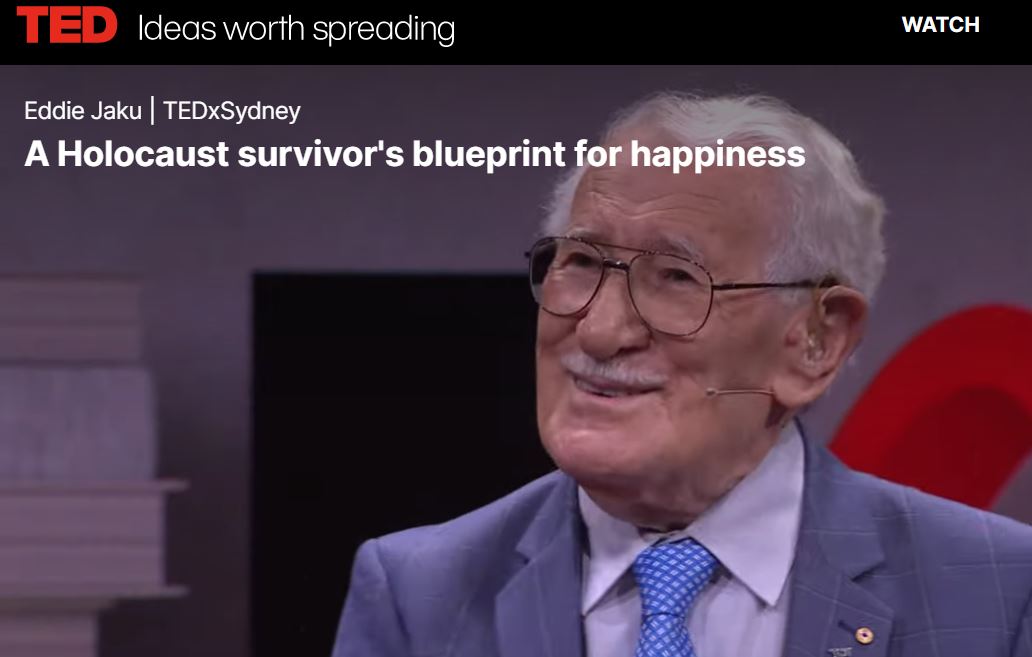
Ted Talk

Eddie Jaku: A Holocaust Survivor's Blueprint for Happiness
Quotes that stuck out to me:

  • "My dear new friends ... (Laughter) My name is Eddie Jaku, and I'm standing in front of you today, a survivor of the Holocaust and a witness of the most tragic times in the history of mankind." (Ethos) 
  • "I lost my dignity, my freedom, and my faith in humanity. I lost everything I lived for. I was reduced from a man to being nothing." (Pathos) 
  • "I did not have a chance to say goodbye to my beloved mother, and I have missed her every day of my life. If you have the opportunity today, please go home and make sure you tell your mom how much you love her. Please do this for your new friend, Eddie." (Pathos) 
  • "But I'm standing here today a happy man, who enjoys life with a wonderful wife and a beautiful family. I do not hate anyone. Hate is a disease which may destroy your enemy, but will also destroy you in the process." (Pathos) 
  • "Happiness does not fall from the sky; it's in your hands." (Logos) 
Eddie Jaku is a man who has seen far beyond what we all know. He is a man that has experienced the tragedies of World War II and the mass slaughter of his own people, just for being Jewish. Jaku talks about the battles he has survived from the Holocaust-- the burning of his home, the death of his dog, the camps he was taken to, and the loss of his parents. As he tells the story of each new challenge, he shares all the darkness within that moment. Jaku discusses the horrors that haunt humanity and have many of us wondering again and again how someone could treat another in the way he was treated-- in the way Jews were treated. But after each new challenge and after each fight against all odds, Eddie Jaku talks of hope. He speaks of his miraculous survival, his wife and kids, and the happiness he has reclaimed from life. This Ted Talk is about valuing what you have and taking a moment to be grateful for the light in your life. Eddie Jaku proclaims that hope and happiness can never be lost, even in the darkest of times. Through his talk, he offers advice to his audience of how they should focus on their personal happiness and reclaim it themselves if lost. 

Jaku alone, just standing before the audience, a smile on his face is an inspirational image. But his words, heartfelt and filled with a deep rooted passion, stir up emotions far beyond just inspiration. This particular talk relied on the combination of ethos and pathos. I personally, do not think Eddie was trying to persuade the incidence in any way-- but rather share what he himself has learned through his troubles. The ethos of the matter, is that of personal experience. Eddie Jaku is a Holocaust survivor who first hand went through all of which he describes. There is no greater reliability than that of personal experience. If he, a man who has gone through all of that hardship-- most likely the worst of humankind-- can end up happy, than it must be true everyone else can as well. Through this perspective, the audience hangs on to each word and story he has to tell. Eddie Jaku has seen more and felt more than all of us can imagine, and through this, the audience puts great stock in his words. 

The pathos comes along with each story. As he begins his story, starting with when he was first taken from his home, he recalls specific details and emotions with each memory. Jaku brings in his senses at the time to develop the imagery of these memories, because to him, they are just as clear as ever. This helps the audience connect to what he is saying by being able to imagine it themselves. The pure horror that comes from each hardship, and the questions on human nature that arise from it, create a deep emotional reaction for most audience members. As we listen, we become attached to Eddie Jaku and his story. With each new piece of information, we sympathize more and more with him, truly experiencing heartache for what he, and many others, had to experience. It is, however, the hope at the end of each story that really triggers the emotional reaction. As an audience, we want nothing but happiness for Jaku and peace of mind. So when he explains that he has both, the feeling one gets is hard to put into words. It is the most heartwarming feeling of all because if anyone deserves happiness, it is someone like Eddie Jaku. 

The advice he gives is simple and logical. It is straightforward and wholesome. He wants us to be grateful-- to love and appreciate our friends and family. He wants us to stop and admire the world we have and all the happiness that comes with it. But most importantly, Jaku wants us to take happiness into our own hands. This use of logos is within this simple message. It is one no one can deny, especially not from someone like Eddie Jaku. He combines this logic, with the credibility from his life experience, to push advice onto his audience that they will likely take to heart. 

I would safety bet each member of that audience left feeling different, changed in some way. Eddie Jaku is able to effectively give such a powerful Ted Talk through the blending of all three of these elements-- but above all, through the kindness in his own heart and the love he has to share. 

I picked this Ted Talk within about twenty seconds of reading all the titles. At first, I was drawn in by the man on the front-- Eddie. I have always had a love of old people and his smile just radiated joy. When I read the title, I absolutely knew I had to watch it. Happiness to me is my whole goal in life. I have spent a lot of time in my own personal darkness, just like Eddie, on a different scale. Through that darkness, I have found what I believe to be the beginnings of my own light in life-- my own happiness. I wanted to watch this Ted Talk because I felt if Eddie Jaku could find himself happy after all he went through, I certainly could. I have to admit, I bawled the entire time I watched the video and wrote this blog. Simply because the subject of happiness hits close to home and as an individual, I sympathize deeply for others. Just like those audience members, I can say that the Ted Talk did change me in some way and my friend, Eddie Jaku, helped me see the light a little more clearly. 

Sunday, January 12, 2020

Jekyll and Hyde

Image result for dr. jekyll and mr. hyde
Image Citation

Excerpt Character Analysis 

Mr. Hyde

"He is not easy to describe. There is something wrong with his appearance; something displeasing, something downright detestable. I never saw a man I so disliked, and yet I scarce know why. He must be deformed somewhere; he gives a strong feeling of deformity, although I couldn't specify a point. He's an extraordinary looking man, and yet I really can name nothing out of the way" (Stevenson 5).

Through this description of Mr. Hyde, his physical appearance reflects the personality he is associated with throughout the story. Not only is he of a lower class, and therefore ugly and dis-likable, but he is different from the average person-- deformed. He rubs off negatively on those who encounter him because his behaviors are cruel and stun those who observe them. The fact that he is hard to describe and place concrete details brings in the gothic theme. This causes the readers to fear someone that is less human and represents more of a monster of sorts that they wouldn't be able to recognize. It also brings in the element of the uncanny. The general reaction to Mr. Hyde represents how many upper class members would feel on those of the lower class and the changes within society.

Dr. Jekyll
"To this rule, Dr. Jekyll was no exception; and as he now sat on the opposite side of the fire-- a large, well-made, smooth-faced man of fifty, with something of a stylish cast perhaps, but every mark of capacity and kindness-- you could see by his looks that he cherished for Mr. Utterson a sincere and warm affection. "I have been wanting to speak to you, Jekyll," began the latter. "You know that will of yours?" A close observer might have gathered that the topic was distasteful; but the doctor carried it off gaily. "My poor Utterson," he said, "you are unfortunate in such a client. I never saw a man so distressed as you were by my will; unless it were the hide-bound pedant, Lanyon, at what he called my scientific heresies. O, I know he's a good fellow-- you needn't frown-- an excellent fellow, and I always mean to see more of him, but a hide-bound pedant for all that; an ignorant, blatant pedant. I was never more disappointed more in any man than Lanyon." "You know I never approved of it," pursued Utterson, ruthless disregarding the fresh topic. "My will? Yes, certainly, I know that," said the doctor, a trifle sharply. "You have told me so." "Well I tell you so again," continued the lawyer. "I have been learning something of young Hyde." The large handsome face of Dr. Jekyll grew pale to the very lips and there came a blackness about his eyes. "I do not care to hear more," said he. "This is a matter I thought we agreed to drop" (Stevenson 12-13).

Through this excerpt, it is modeled that physically Dr. Jekyll is well put-together, handsome, and of a high standard/class. He holds high respect and reputation within society. This description completely contrasts that of Mr. Hyde and shows the two opposite sides one man can have. The use of the dialogue conversation here and through the friendship of Utterson and Jekyll, help develop the inner personalities of the characters that aren't seen through their external masks. For instance, Jekyll is outwardly smart and respectable but inwardly struggles with what he is hiding when it comes to his relationship with Hyde. The dialogue conveys emotions lost within just detailed description and allows the audience to connect more to the characters and their behaviors. Also, through Utterson being involved in both excerpts, it shows a typical outsiders pov if in the upper class on people of their own kind vs. those in lower classes. 

Poem 

Voices: Jekyll (Lindsey) and Hyde (Abby)

Our poem’s purpose and intended effect is to portray the immediate contrast between these two characters but highlight where they relate through their shared lines. This in turn shows the duality between man by having these two characters reflect and develop one another. This poem focuses within the decision for Jekyll to leave everything to Hyde in his will before the murder of Danver. It begins to foreshadow the murder and the other events to come as both begin to unravel.


Jekyll Hyde 
It has been decided,                                                 It has been decided,

I'm leaving him everything.           I’m taking everything.

I trust him with--           He trusts me with--

All that I have and all that I am and          A fortune that takes a man out of the
all I could ever hope to be.          shadows, something that could
                             make me all I could ever hope to be.

They say I’m mad, not right in the head, They say I’m evil, a master manipulator,

It fills me with anger to the very brim                 It fills me with anger to the very brim,
How the people I hold close, beat me down. How the upper class beats me thin.

Soon they will see my side too, Soon I will be one of them too,
Look out, Look out,
I’m waiting for you. I’m coming for you.


Sunday, December 15, 2019

Lady Macbeth's Netflix Recommendations


Related image

Image URL
[blog post shows may be inaccurate to the time frame of Macbeth, but would be enjoyed by her if realistic]

I used to watch Netflix marathons with my husband Macbeth, but ever since the plot for power has drawn into action, I have lost him as my partner in crime. As he spends more time away from home and more time in secret, I have found myself diving into a new array of shows. These are my top five favorite Netflix recommendations-- all handpicked by me. Each of the five represent something significant going on in my life and help get me through the days. Enjoy.  Yours truly, Lady Macbeth. 

  1. Forensic Files
    Image result for forensic files
    Image URL
Ever since the night of Duncan's death, I have been wondering nonstop about if and how they could figure out who did the deed. As a result of my worrying, I have been watching at least two Forensic Files episodes a day. Each episode describes how forensic scientists use evidence left at a crime scene and on victims/suspects to solve cases. With every episode, I find myself wondering how long it will be until they are able to lift Macbeth and I's fingerprints, use luminol to recover the blood on our clothes and hands, and pin the crime upon us both. I have watched countless numbers of cases be proved beyond a shadow of a doubt who the killer was. Through this show, I am almost positive that Macbeth and I's time is limited. However, it has indeed taught me a lot about how to get away with crimes. 

       2. Gossip Girl

Image URL
   My true guilty pleasure is that of the teen drama, Gossip Girl. I will admit, this one hits home in the oddest of ways for me. The show follows two Upper-East Side rich girls in Manhattan. Both of them are powerful female figures wanting power and status within their own world. As cheesy as it may be, I often compare Macbeth and I's relationship to that of Chuck and Blair. Throughout the show, they experience significant relationship issues become they are both headstrong and power hungry. While Blair can tell that they are better together as a partnership and should be satisfied with what they accomplished, Chuck continues to struggle with opening up to her and not going off on his own. I mean...talk about spot on. Despite being a show for teenagers, I find myself entranced in the quick pace and drama of the show. It is one of the best ones out there. 

       3. Reign
Related image
Image URl
This breathtaking series keeps me on the edge of my seat with each episode through its twists and turns. I truly adore the depiction of the strong head of the crown being a woman. The show focuses on the turmoil as a ruler of a country and the issues of power that come with it. For me, this directly relates down to the same problems my husband and I are experiencing. The show hits specifically on what it takes to be a ruler and how hard it can be to "keep your head" as one. Specifically, I reincarnate with the so-called glory of what having the crown projects and how it truly only limits you through the poison of power. Reign captures the ambition, the blood tool, and the lust of being a royal. 
      4. Seven Deadly Sins

Image result for seven deadly sins anime
Image URL
When I am craving something light hearted but with a deeper meaning, I usually pick the Seven Deadly Sins manga series. It focuses on this group of knights that come together after ten years apart in hiding for supposedly plotting a coop against their kingdom. However, you find out after hours of binge watching that they were not actually the bad guys, but had saved the kingdom from a demon race trying to control it. I really enjoy this manga because of its emphasis of the supernatural. As the witches have come into my own life, I have found that with them is also evil and danger-- that we are just pawns in their game. It gives me hope that Macbeth and I can free our own name and break away from the clutches of the supernatural. 

     5. 13 going on 30
Image result for going on 30
Image URL
For my fifth and final pick, I am going to go with a classic movie I enjoy. The movie, 3 going on 30, hones in on the concept of character development. A young, newly turned thirteen-year-old wants to be popular and is willing to do anything (such as throw her best friend under the bus) to make that happen. After some events at her birthday party, she wishes to be thirty. The next morning she wakes up into her life as a thirty-year-old if she had become the popular person she wanted to be. She finds that as an adult, she is a horrible human with bad morals. Instead, she changes her life and falls for her old best friend, eventually returning back to thirteen. This movie for me is my inspiration. I know how I have started off with my actions in Duncan's death. But, I also know that I don't want to be that person of live that life anymore. The only problem, I don't have magic that can turn back the time and restart like she does. It seems, as the days go on, my options are growing more and more slim. I may not have any choice but to take myself out of the picture.